
Time for a deep dive into a dark part of Edinburgh’s science history.
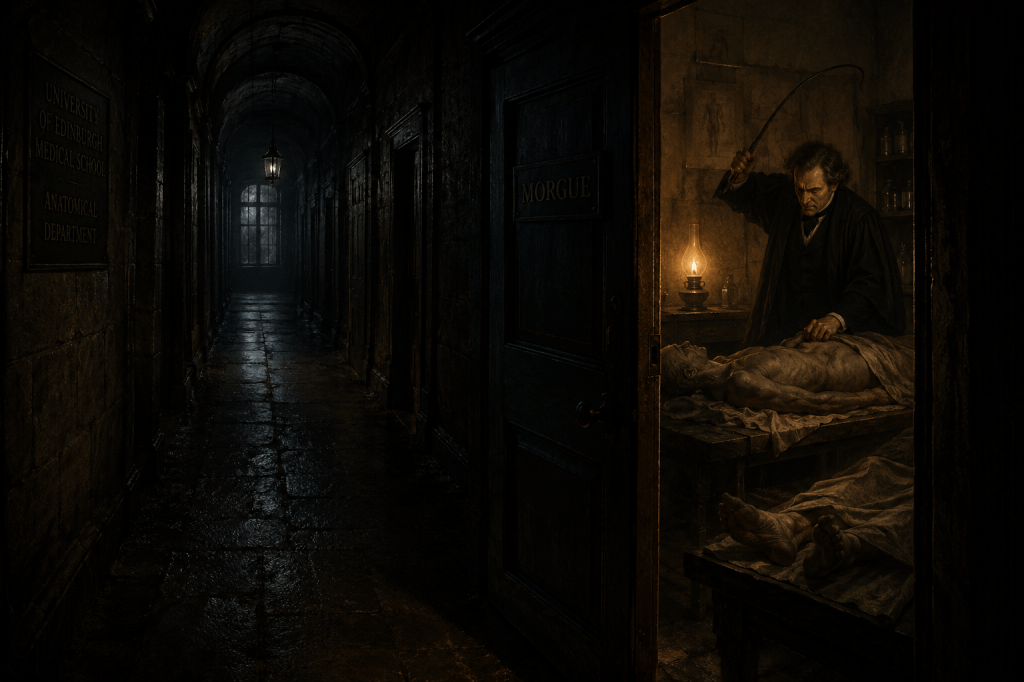
Let’s set the scene: It is a bleak and dark winter evening in late December of 1828. You are walking down the north corridor of the lower ground floor of the University of Edinburgh’s Medical School.
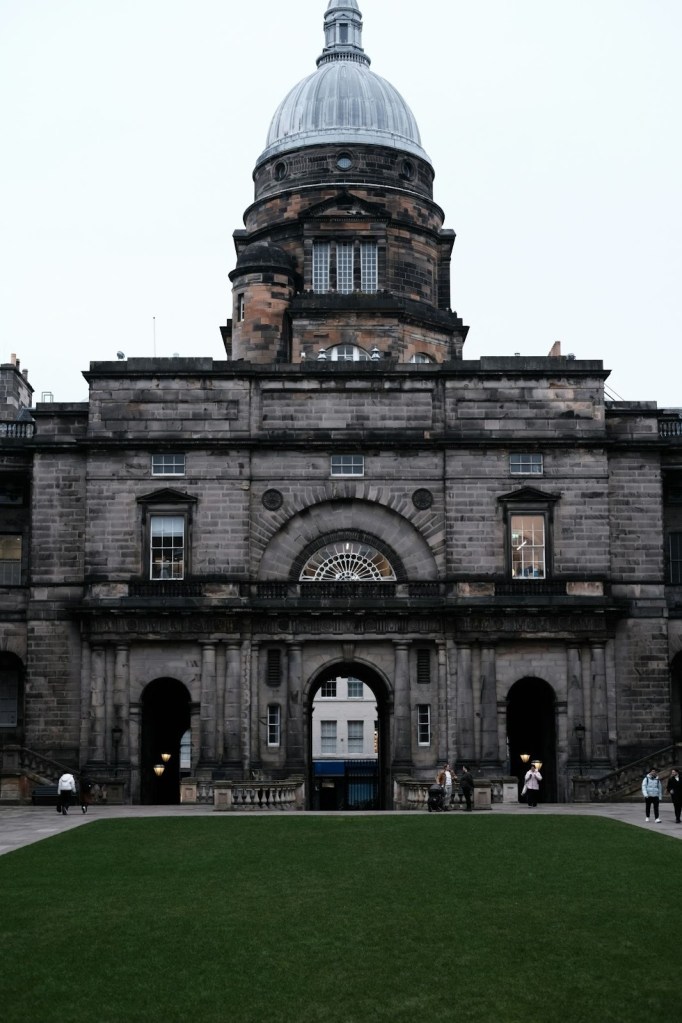
Photo by Mafalda Moura on Unsplash
The icy fog is draping the city like a wet woollen blanket. It has been hours since the sun set and you can’t help but shudder as the cold slowly seeps into your bones. The Medical School is dark and you know you are all alone.
Suddenly you hear a soft thud. An entirely different kind of cold washes over you when you turn a corner and realise that the sound must have come from the morgue. You hear the sound again. A thud again. But sharper, almost like a whip crack this time. The flames of the oil lamps in the morgue cast a flickering square of light through the half-open door onto the corridor floor. You step into the light and push the door open. There, still wearing his black academic robes, is Professor Christison, busy beating up corpses.
This scene that I just made up is inspired by a legend famous among medical students in Edinburgh. Professor Christison was one of the first professors appointed in Medical Jurisprudence and Medical Police. And in 1828 he really did beat up corpses in the morgue of the medical school. Christison is a fascinating character in the science history of Edinburgh. The Edinburgh chair of Medical Jurisprudence was the first of its kind in the UK, and it was established in the early 1800s to make sure that there were medical experts in place to act as expert witnesses in court at the time. Christison was known for being honest and thorough. And he was also known for his experiments.
In the late 1870s one young student at Edinburgh’s medical school seems to have been especially impressed by the stories of the inventive, if unorthodox, behaviour of the old professor. The student’s name was Arthur Conan Doyle.
We can see Christison’s influence in the very first Sherlock Holmes mystery that Conan Doyle wrote: “A Study in Scarlet”. Here is a snippet from the novel, where our trusty Dr Watson is about to be introduced to Sherlock for the first time, by his old friend Stanford:
Stanford: “[Sherlock] appears to have a passion for definite and exact knowledge.”
Watson: “Very right too.”
Stanford: “Yes, but it may be pushed to excess. When it comes to beating the subjects in the dissecting-rooms with a stick, it is certainly taking rather a bizarre shape.”
Watson: “Beating the subjects!”
Stanford: “Yes, to verify how far bruises may be produced after death. I saw him at it with my own eyes.”
And that is in fact the very reason that Christison was beating up corpses in December of 1828. To study bruising after death. Earlier that month he had been called to investigate the deceased remains of Margaret Docherty. Margaret Docherty was the final victim of the infamous serial killers Burke and Hare, who murdered poor and lonely people only to sell their remains to the medical school doctors for their educational autopsies. A very dark time in Edinburgh’s medical history, and no doubt an awkward situation for the medical school’s professors to be in! When Ms. Docherty’s remains were investigated, Professor Christison found signs that she had died of asphyxiation. But she also had some very odd looking bruises on her body and a broken neck. One evening Christison took it upon himself to study bruising and figure out the degree to which a human body can acquire bruising after death. And that is how we find him in the morgue in our story. By beating the bodies, and observing the development of bruises, he became convinced that Margaret Docherty’s bruises were from after she had died. He suggested that the bruises on her body were from having been forced into a small space soon after death.
Christison gave his evidence in court. He might be known as an honest man and a trusted expert witness for the Crown. But would his evidence lead to a conviction of the two men? There was very little other evidence. The Crown Prosecution made the decision that they would rather convict ONE man than fail to convict either. So they convinced Hare to testify against his companion Burke, in exchange for complete immunity. Hare told the full horrifying story, which was darker than the prosecution had thought. Sixteen people had been killed by the pair and their remains sold to various medical professors for use in public anatomy lectures. Mr Hare told the jury that Margaret Docherty, just like all of their victims, had been plied with alcohol until she lost consciousness. One of the men had then laid across her body whilst the other had held her nose and mouth until she died. The body had then been forced into a small tea chest for transport to the medical school. Christison’s evidence was corroborated and it was determined that Hare’s story was true. On Christmas Eve of 1828 Burke was found guilty. His punishment was to be hanged and then publicly dissected and his remains used in medical research.Today the skeleton of Burke still hangs on display in the University of Edinburgh medical school museum.
Edinburgh is full of dark tales from the history of science and medicine! I will no doubt come back to the full story of Burke and Hare in a future post, and will certainly write more about Sir Arthur Conan Doyle’s time in Edinburgh, so look out for that if you are interested. Or book yourself and your friends/colleagues/research group onto the Scientific Wanders walking tour of Edinburgh, and I’ll tell you all about it in person! Fill in the form here, and I’ll get you booked in:
Book your Scientific Wander here
If you listen to podcasts I also really recommend the Surgeon’s Hall podcast “Under the Knife”; especially the episode Medical Detectives, that will tell you more about Christison and other professors of Medical Jurisprudence from the 19th century.

